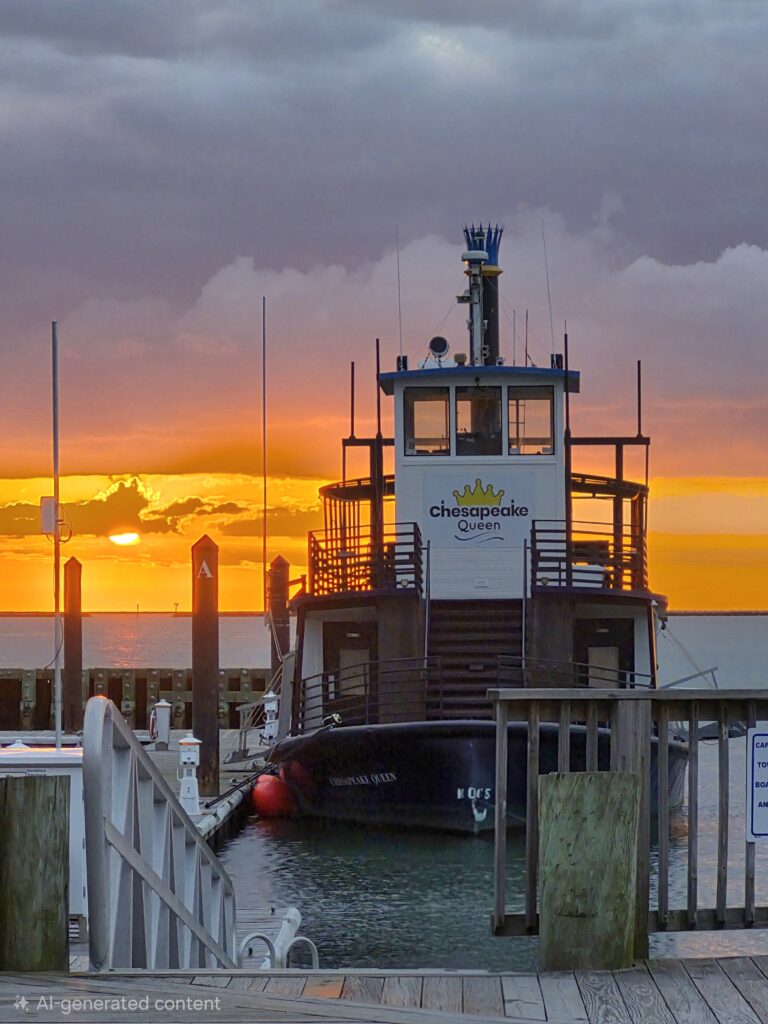
The Chesapeake Queen
A Historic Ferry Reimagined for Cape Charles
The Chesapeake Queen comes from one of America’s oldest transportation traditions: the Elizabeth River Ferry, first launched in 1636. That original crossing began with a simple hand-rowed skiff moving settlers between Norfolk and Portsmouth. As the region grew, the ferry evolved from larger rowboats and pole-powered barges, then to early paddle craft operated by a small crew. By the 1700s and early 1800s, the service included boats large enough to carry wagons and small vehicles, and even “team boats” powered by horses or mules walking on onboard treadmills.
A major shift arrived in 1832 with the introduction of steam power. Faster and more reliable vessels dramatically improved the short crossing and supported the area’s expanding commerce. Through the late 19th and early 20th centuries, the ferries continued to modernize, eventually adopting diesel propulsion and carrying significant numbers of passengers and vehicles each day.
The rise of tunnels and bridges in the mid-20th century brought an end to car ferry operations by 1955, as faster road connections replaced the need for vehicular boats. After a brief attempt to revive service privately, the ferries went silent until 1983, when passenger-only service was restored to support revitalization efforts along both waterfronts. Since then, the route has remained a hallmark of the Hampton Roads region and one of the country’s oldest continuous ferry traditions.
Today, that lineage takes on a new chapter in Cape Charles. The vessel now known as the Chesapeake Queen was purchased at auction and brought here as part of Dawn’s long-held dream to give the boat a new purpose and a new home. Though she is no longer here to see it, her vision has been carried forward, and the Chesapeake Queen now stands as a living connection to nearly 400 years of maritime history.
A historic vessel. A renewed mission. A legacy brought to life on the Eastern Shore.